A Word From Pastor Robert
I’ve sat across the table with people chasing “the good life” in a hundred different forms — a bigger paycheck, a better relationship, a fresh start, a title, a home, peace of mind. I’ve chased some of those things myself. And what I’ve learned, both in ministry and in my own walk with the Lord, is that most of us are running hard after something we’ve never actually stopped to define. We say we want “good,” but we’re often borrowing someone else’s definition of it — a definition shaped by culture, comparison, or circumstance rather than by the Word of God.
That question has stayed with me: what actually is the good we’re after? Not the good we feel in the moment, but the good God Himself calls good. I wanted to bring this teaching to you because I believe far too many of us are pursuing a counterfeit — chasing comfort and calling it blessing, chasing approval and calling it purpose. Scripture gives us something far more solid to stand on. My prayer is that as you read this, the Lord will recalibrate what you’re aiming for, so that what you call “good” is actually what He calls good.
Let’s look at what His Word says.
The Foundation
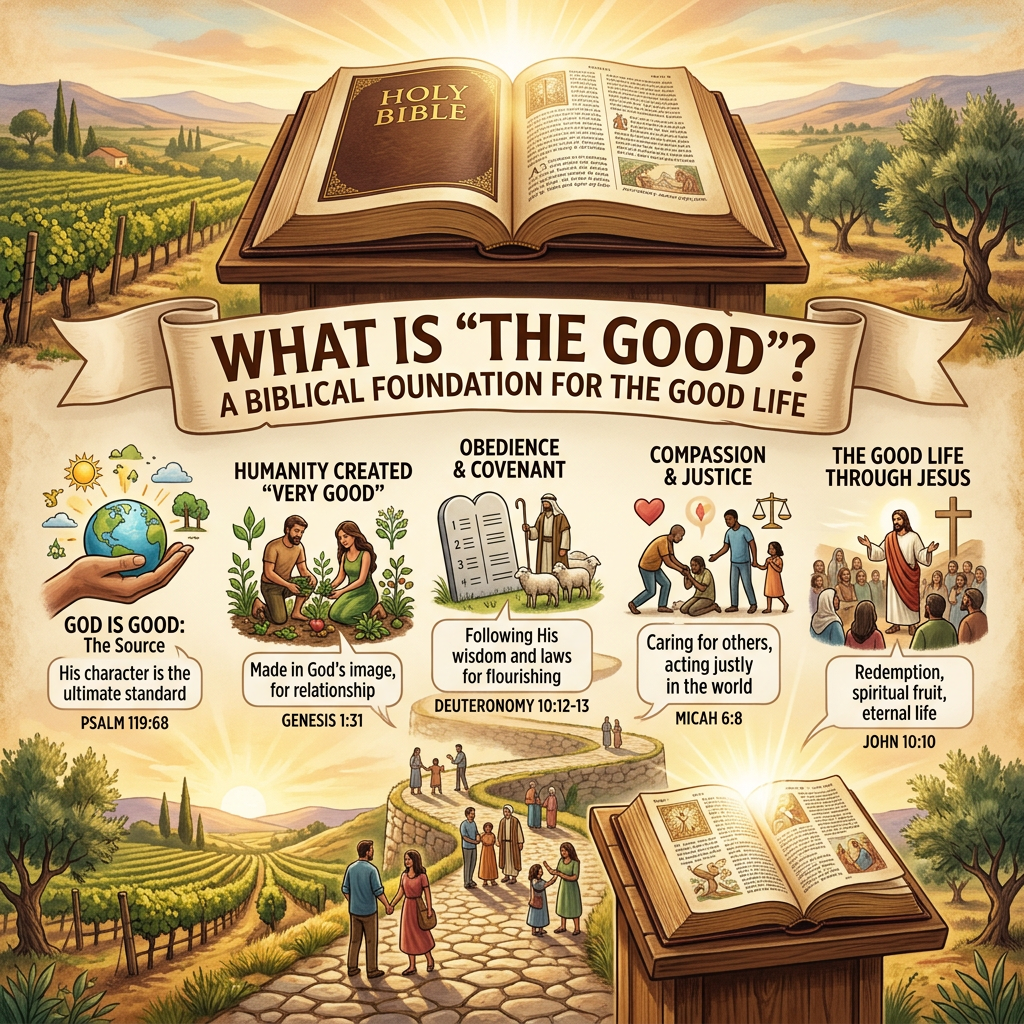
Everyone wants to live a good life. It’s one of the few desires that crosses every culture, every generation, every background. We build careers, raise families, chase dreams, and make daily decisions all in pursuit of something we call “good.” But if we’re honest, the word gets used so loosely that it starts to lose meaning. Good according to whom? Good measured how? Good for how long?
Scripture doesn’t leave us guessing. The Bible gives real clarity — not a vague feeling, but a defined standard — for what “the good” actually is, where it comes from, and how we lay hold of it.
The Good Begins With God, Not With Us
Before we can define what is good, we have to settle where goodness originates. Jesus addressed this directly:
“So Jesus said to him, ‘Why do you call Me good? No one is good but One, that is, God.’” — Mark 10:18
This is foundational. Goodness is not a human invention or a cultural consensus — it is an attribute of God’s own character. He is the source and the standard. When Genesis describes creation, the refrain repeats:
“Then God saw everything that He had made, and indeed it was very good.” — Genesis 1:31
What Scripture explicitly says: God alone is the ultimate standard of goodness, and what He calls good is good because it reflects His nature and His design.
Interpretation: This means “good” is not something we get to define for ourselves based on feeling, culture, or preference. It is something we receive from Him and measure ourselves against.
The Good Is Not the Same as the Comfortable
One of the biggest confusions believers face is equating “good” with “comfortable,” “easy,” or “pleasurable.” Scripture challenges that assumption directly. Paul writes:
“And we know that all things work together for good to those who love God, to those who are the called according to His purpose.” — Romans 8:28
Notice — this promise doesn’t say all things feel good or are pleasant. It says God works all things toward good, for those walking in relationship with Him. Good, biblically, is often tied to purpose, growth, and conformity to Christ rather than immediate comfort:
“For whom He foreknew, He also predestined to be conformed to the image of His Son, that He might be the firstborn among many brethren.” — Romans 8:29
Application: This reframes how we should evaluate our circumstances. A season of difficulty is not evidence that God has withheld good from us — it may be the very means He is using to produce it.
The Good Life Has a Definition, Not Just a Feeling
Scripture actually spells out, in practical terms, what a life pursuing “the good” looks like. The prophet Micah gives one of the clearest summaries in the entire Old Testament:
“He has shown you, O man, what is good; and what does the LORD require of you but to do justly, to love mercy, and to walk humbly with your God?” — Micah 6:8
This is not abstract. It’s actionable:
- Do justly — live with integrity and fairness toward others.
- Love mercy — extend the same compassion God has extended to us.
- Walk humbly with God — maintain an ongoing, submitted relationship with Him.
David echoes this pursuit of the good as something to be tasted and experienced, not merely believed:
“Oh, taste and see that the LORD is good; blessed is the man who trusts in Him!” — Psalm 34:8
What Scripture explicitly says: Goodness is inseparable from relationship with God and righteous conduct toward others — it is not a private, self-defined pursuit.
Every Good Gift Comes From the Father
James makes it plain that goodness is not something we generate on our own strength. It flows from God as its source:
“Every good gift and every perfect gift is from above, and comes down from the Father of lights, with whom there is no variation or shadow of turning.” — James 1:17
This matters because it corrects a common cultural distortion — the idea that the “good life” is something we manufacture through achievement, wealth, or self-improvement. Scripture teaches that lasting good is a gift received through relationship with the Giver, not a product we engineer independently of Him.
Interpretation: This doesn’t mean effort, wisdom, or stewardship don’t matter — Scripture calls us to diligence elsewhere. But it does mean the deepest and most lasting good in our lives is sourced in God’s grace, not solely in our own striving.
Do Not Be Conformed — Be Transformed to Know the Good
Paul gives believers the practical key to actually discerning what is good in everyday decisions:
“And do not be conformed to this world, but be transformed by the renewing of your mind, that you may prove what is that good and acceptable and perfect will of God.” — Romans 12:2
This tells us something important: discerning “the good” requires a renewed mind. It is not automatic, and it is not the same as following the crowd or the culture. It comes through ongoing transformation — walking with God, studying His Word, and allowing the Holy Spirit to reshape how we think.
Application: Practically, this means testing our decisions, ambitions, and definitions of success not by cultural approval but by the Word of God and the leading of the Holy Spirit.
Bringing It Together
So what is the “good” that we truly want to have and to be?
- It is rooted in God’s character, not human opinion (Mark 10:18).
- It is often produced through difficulty and shaped toward Christlikeness, not just comfort (Romans 8:28-29).
- It has a defined, practical shape — justice, mercy, and humble relationship with God (Micah 6:8).
- It is received as a gift from the Father, not manufactured by our own strength alone (James 1:17).
- It is discerned through a transformed mind, not conformity to the world (Romans 12:2).
The good life, biblically, is not a feeling we chase — it is a Person we follow. The pursuit of “the good” ultimately leads every honest heart back to Jesus Christ, in whom all goodness is fully revealed and fulfilled.
“And I, if I am lifted up from the earth, will draw all peoples to Myself.” — John 12:32
If you are wrestling with what “good” should look like in a specific decision or season of your life, that is worth bringing before the Lord in prayer and testing against Scripture — and where the matter touches significant life direction, it is wise to seek godly counsel and pastoral guidance as well.
Pastor, Robert M. Thomas, Jr. The Gathering Place Houston – Fellowship of Believers





Leave a Reply