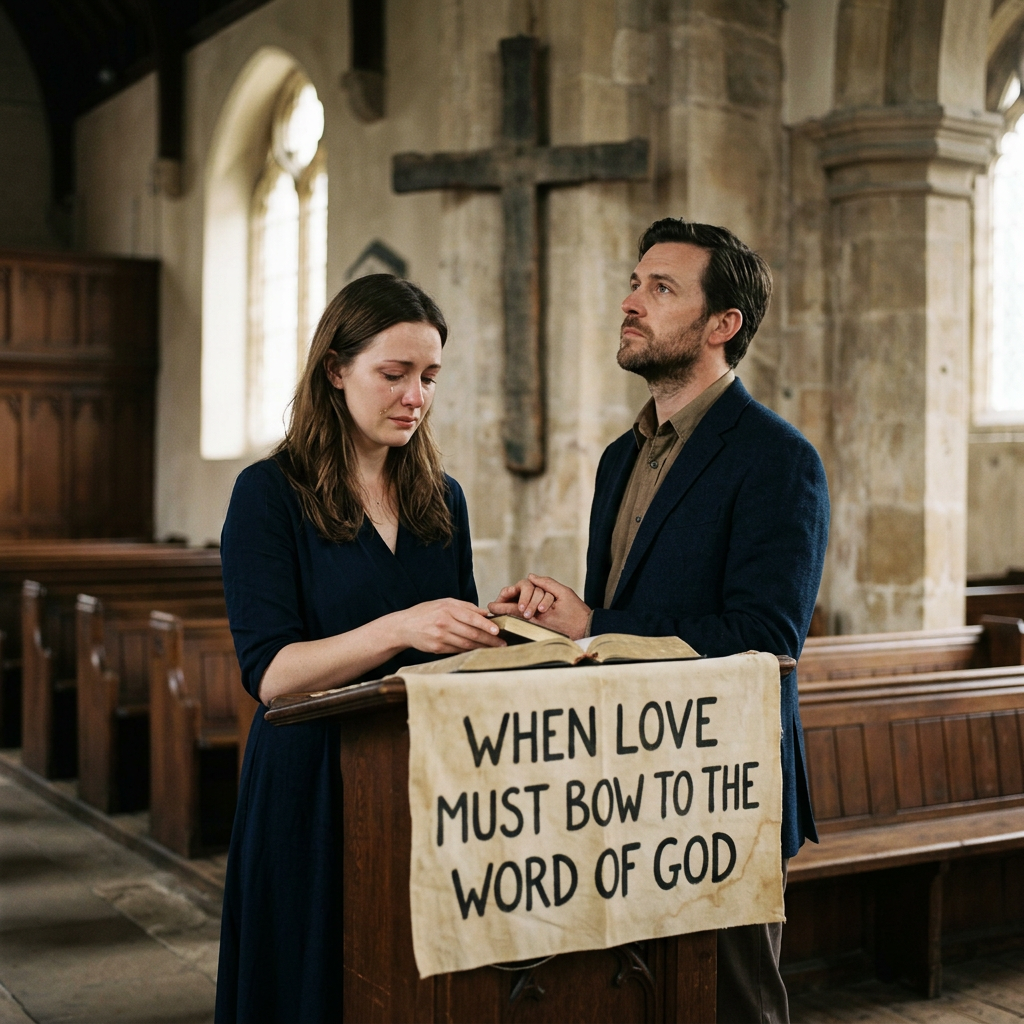
Marriage, Sexual Purity, and the Call to Obedience
There are moments in life when two people meet, develop affection for one another, and eventually find themselves deeply connected emotionally, romantically, and physically. Feelings become strong. Attachment becomes real. Desires become difficult to restrain. And before long, two individuals may find themselves participating in a relationship that has crossed boundaries established by the Word of God.
But here is the question every believer must eventually face:
What do we do when our feelings have taken us somewhere our obedience to God has not permitted us to go?
The answer cannot simply be, “We love each other.”
Love is important, but biblical love does not give us permission to disobey God.
The Christian life is not built upon feelings alone. It is built upon faith, truth, obedience, repentance, and surrender to the will of God.
Jesus said:
“If ye love me, keep my commandments.”
— John 14:15
That statement places love and obedience together.
WHEN TWO PEOPLE FALL INTO A ROMANTIC RELATIONSHIP
A relationship can begin innocently.
Two people may begin talking. They discover common interests. They pray together. They encourage one another. Emotional attachment develops. Eventually, romantic affection enters the relationship.
But affection can become powerful.
The heart can begin to desire what God has not yet authorized.
This is where wisdom is required.
There is nothing inherently sinful about a man and woman developing an honorable desire to marry. Marriage itself is God’s institution, established from the beginning of creation.
Genesis 2:24 declares:
“Therefore shall a man leave his father and his mother, and shall cleave unto his wife: and they shall be one flesh.”
The problem is not that two people have fallen in love.
The problem occurs when they allow the relationship to operate outside the boundaries God established for sexual intimacy.
God created sexual intimacy. Therefore, sexuality is not evil.
But what God creates, He also has the authority to regulate.
The covenant of marriage provides the biblical framework for sexual union between a husband and wife.
That means a relationship cannot be justified merely because the emotions are sincere.
Something can feel genuine and still be outside God’s order.
WHEN SIN HAS ALREADY OCCURRED
This is where many people become confused.
Suppose two unmarried people have entered into sexual intimacy.
What should they do?
The answer is not to pretend nothing happened.
The answer is not to continue in the behavior simply because it has already happened.
And the answer is not to believe that past failure means they are permanently disqualified from walking with God.
The biblical response is repentance and obedience.
The apostle John writes:
“If we confess our sins, he is faithful and just to forgive us our sins, and to cleanse us from all unrighteousness.”
— 1 John 1:9
Notice the language:
confess.
forgive.
cleanse.
God’s mercy does not give us permission to continue sinning. God’s mercy gives us an opportunity to turn around.
Paul asked:
“Shall we continue in sin, that grace may abound?”
— Romans 6:1
His answer was unmistakable:
“God forbid.”
Grace is not permission to remain where God has commanded us to leave.
DO NOT TURN A FALL INTO A LIFESTYLE
There is an enormous difference between falling into sin and choosing to remain in sin.
A person may stumble.
A person may make a terrible decision.
A person may allow desire to overpower wisdom.
But once the Holy Spirit brings conviction and the Word of God reveals the truth, the believer has a decision to make.
Will I repent?
Or will I rationalize?
Will I obey?
Or will I continue?
Will I bring my relationship under the authority of Christ?
Or will I ask Christ to bless something I refuse to surrender?
That is the deeper issue.
The question is not simply, “Do we love one another?”
The question is:
“Are we willing to love one another according to the will of God?”
WHEN SEXUAL DESIRE BECOMES DIFFICULT TO CONTROL
Scripture does not ignore human sexual desire.
Paul addresses it directly.
In 1 Corinthians 7:9, he writes:
“But if they cannot contain, let them marry: for it is better to marry than to burn.”
This passage must not be twisted into a casual justification for sexual behavior.
Paul is not saying, “If you desire someone, simply have sex and then get married.”
Rather, he recognizes that sexual desire is real and teaches that marriage is the God-ordained covenant within which sexual intimacy belongs.
This gives us an important biblical principle:
If two people genuinely desire one another, cannot maintain sexual self-control, and are prepared to enter the covenant responsibilities of marriage, they should seriously consider marriage rather than continuing in sexual immorality.
But marriage is not merely an escape route from temptation.
Marriage is a covenant.
Marriage means responsibility.
Marriage means faithfulness.
Marriage means sacrifice.
Marriage means learning to love when emotions are high and when emotions are low.
Marriage means submitting the relationship itself to God.
Therefore, nobody should rush into marriage simply because they are trying to cover up sexual sin.
The question must become:
Are we truly prepared to become husband and wife before God?
MARRIAGE IS MORE THAN A WEDDING
Modern culture can reduce marriage to a ceremony, a photograph, a ring, a dress, a celebration, or a legal document.
Biblically, marriage is far deeper.
It is covenant.
Malachi 2:14 refers to the wife as a man’s “covenant.”
That word should cause us to slow down.
A covenant carries responsibility.
A husband cannot simply say, “I love her,” while refusing the responsibility of husbandhood.
A woman cannot simply say, “I love him,” while refusing the covenant responsibilities of marriage.
Biblical marriage calls both individuals into a new order of life.
Ephesians 5 presents marriage as something profound enough to illustrate the relationship between Christ and His Church.
That means marriage should not be entered merely because two people cannot control their physical desires.
They should enter marriage because they are prepared to build a covenant life under God.
IF YOU HAVE ALREADY CROSSED THE LINE
Then hear this clearly:
Do not allow shame to drive you farther away from God.
Run toward Him.
Repent.
Confess the matter before God.
End the sinful behavior.
Establish boundaries.
Seek godly counsel.
And honestly examine whether marriage is the proper next step.
If the relationship is genuinely intended for marriage, then stop treating it like a marriage while refusing to become married.
There must be alignment between what you say you believe and how you live.
If marriage is not appropriate or the relationship is not truly intended for covenant commitment, then both individuals may need to separate rather than continuing to feed a relationship that repeatedly produces sexual sin.
This is where spiritual maturity becomes visible.
Sometimes obedience means saying:
“I love you enough to stop doing what is destroying our obedience to God.”
That is not hatred.
That is not rejection.
That is not weakness.
Th






Leave a Reply